
Understanding
comes before
treatment.
Tinnitus is different for everyone. A specialist assessment helps us understand what may be contributing to, exacerbating or maintaining your symptoms — and what, if anything, needs to happen next.
Your assessment begins before you walk through the door.
Ninety minutes goes quickly. Before your appointment, you'll be asked to complete some questionnaires and provide information about your tinnitus, hearing, sound tolerance and relevant history.
Allow approximately 15 minutes to complete these. The information helps us plan your appointment and spend more of your consultation investigating what is relevant to you.
The more we understand before you arrive, the more useful your face-to-face appointment can be.
What happens when we look beyond 8 kHz?
Compare conventional and extended high-frequency testing.
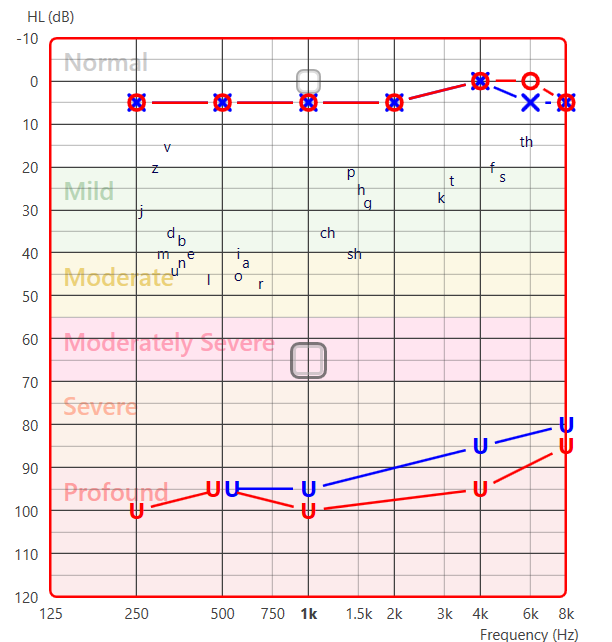
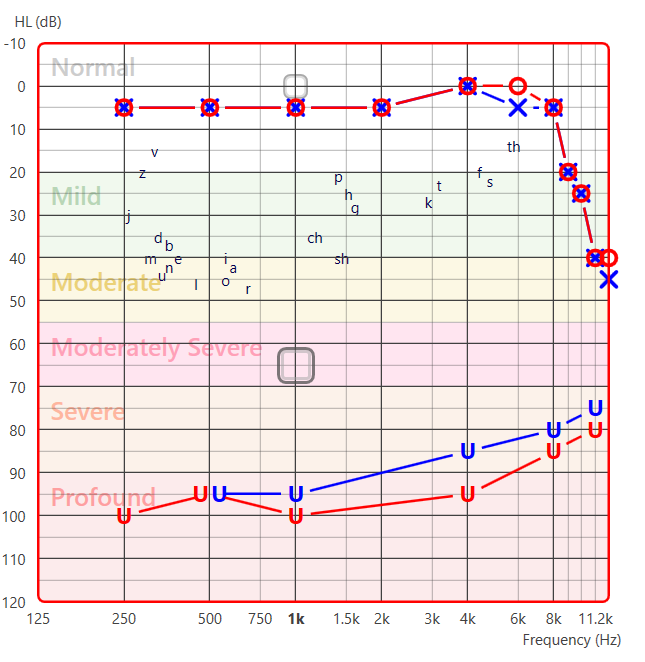
Hearing appears within the conventional normal range through 8 kHz, while extended testing provides additional information at higher frequencies.
Tinnitus needs more than a basic audiogram.
A standard hearing test is primarily designed to answer an important question: do you have a measurable hearing loss?
But when you have tinnitus, hearing thresholds may only be one part of the picture.
People can experience tinnitus despite having hearing thresholds within the conventional “normal” range. Others may have difficulty hearing in background noise, changes at extended high frequencies, differences in cochlear function or sound sensitivity.
A specialist tinnitus assessment looks beyond your hearing thresholds to understand the whole presentation.
A normal conventional audiogram does not mean there is nothing more to investigate — and it certainly does not mean your symptoms are not real.
We don't perform tests simply because they're available.
Your history and symptoms guide what we investigate.
Thorough case history
Onset and behaviour of your tinnitus, hearing history, noise exposure and relevant health factors.
Diagnostic hearing assessment
Detailed testing to understand hearing function and clinically relevant changes.
Extended high-frequency audiometry
Testing beyond the conventional audiogram when clinically useful.
Speech-in-noise testing
Helps investigate real-world listening difficulties.
Cochlear function testing
Otoacoustic emissions may provide additional information about cochlear function.
Sound tolerance
When sound sensitivity is relevant, tolerance may be assessed carefully.
Tinnitus characteristics
Pitch and loudness matching may be used when clinically useful.
Musculoskeletal screening
We consider jaw, neck and other somatic influences.
Additional testing when indicated
ABR may be considered for some presentations, including unilateral tinnitus, and is available at our Kent Town clinic when appropriate.
Hearing is only part of the picture.
Tinnitus can be influenced by a range of auditory, physiological and contextual factors.
- Hearing and auditory changes
- Sound sensitivity
- Stress and nervous-system arousal
- Sleep and fatigue
- Attention and emotional response
- Jaw, neck or somatic influences
- Medical or otological factors
The aim is to identify the factors that appear relevant to your presentation so management can be approached in the right order.
If underlying sound sensitivity is present, addressing sound tolerance is often an important early priority.

Understand. Investigate. Explain. Plan.
There is no standard tinnitus appointment because there is no standard tinnitus patient.
Understand
We begin with your history and what matters most to you.
Investigate
Testing is selected according to your symptoms and presentation.
Explain
We explain what your results mean and how the pieces may fit together.
Plan
We decide what should happen next — and in what order.
You leave knowing what happens next.
You will receive a verbal explanation of your results and initial recommendations during your appointment.
We will also provide notes about your interim management plan while your comprehensive report is being prepared.
For many people, the assessment and personalised management plan are all they need initially.
Clear explanations without unnecessary jargon or alarm.
Practical recommendations you can begin after your appointment.
Prepared within approximately one week.
We can write to your referring GP, ENT or other clinician where appropriate.
We help guide the next step if another clinician should be involved.
Ongoing treatment is discussed only after we understand your presentation.
Assessment fee: $300
A referral is not required to book a private tinnitus assessment.
Depending on your circumstances, Medicare or DVA funding may apply. The Australian Government Hearing Services Program can fund eligible hearing services, but does not cover specialist tinnitus assessment or tinnitus management.
Our Fees, Rebates & Funding page explains the different pathways.
View Fees, Rebates & Funding →Medicare rebates may be available for eligible diagnostic audiology services when referral requirements are met.
HSP provides eligible clients with subsidised hearing services and devices.
Specialist tinnitus assessment and tinnitus management are not funded under HSP.
You may remain with your existing HSP provider for hearing care and see us privately for specialist tinnitus care.
Eligible veterans may have access to DVA-funded tinnitus assessment and treatment.
Please contact us before booking so we can confirm the correct pathway.
Being told to “just live with it” can leave people frightened, dismissed and unsure where to turn next.
There may not be one medication, operation or universal cure for tinnitus — but that is very different from saying there is no treatment, no rehabilitation and no way to reduce the impact tinnitus has on your life.
You may simply need someone with specialist tinnitus training to look at the problem differently.
Start with understanding.
You do not need to choose a tinnitus treatment before your first appointment. We assess first, explain what we find, and then decide whether anything further is needed.
If you need more support after your assessment, we're here for you.